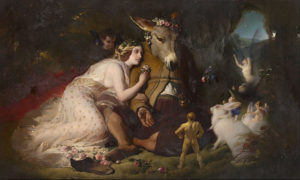
 In William Shakespeare’s A Midsummer Night’s Dream, the word “dream” appears repeatedly, sometimes referring to actual dreams, the fantastical night in the forest, plays, which are dreams upon a stage, and love, which seems to be a passing fancy.
Liberate Yourself with Meta-Awareness, But Don’t Let It Kill the Romance
Becoming a reader and critic of his own story leads Don Quixote eventually to sanity. Toward the end of the second volume, he slips out of his chivalric role more and more often, even doubting his most fabulous adventure: the Cave of Montesino. When an “enchanted boat” capsizes and gets pulverized in a mill, the bedraggled knight, dripping on the bank, sputters, “Yo no puedo más” (Cervantes Saavedra 752) (“I can’t take it anymore”), betraying a defeatist attitude for the first time. His increased meta-awareness causes our heroic knight to lose faith in his chivalric role, drop the pretense, and return, alas, to sanity.

The Constructed Reader
Every text constructs a reader for itself. (You, my friend!) Whenever writers write, it is with the assumption that they are addressing others who do not know what they are explaining. Each time a narrator “recounts facts which he knows perfectly well,” writes Barthes, we find “a sign of the reading act, for there would not be much sense in the narrator giving himself information” (“An Introduction” 260).
Let’s test this assertion by considering a couple of potential exceptions. How about a note to self, like “Don’t forget to call Dad on Father’s Day”? Wouldn’t that be a “narrator giving himself information”? Actually, I would be writing to a future me who may have forgotten, therefore, a constructed reader who does not know.
Don Quixote: The Origin of Modern Realism and Metafiction
 Adapting genres, Cervantes created two new ones: realism and metafiction, says Robert Alter in Partial Magic (1979). The “juxtaposition of high-flown literary fantasies with grubby actuality” established realism, while the “zestfully ostentatious manipulation” of the artifice of literary creation set precedent for “all the self-conscious novelists to come” (Alter 3 – 4). Realism and metafiction were born on the same day and became, almost immediately, rivals. Metafiction is the elder brother, however, since realism was a metafictional technique Cervantes created to parody the conventions of romance. Most fiction since Cervantes, says Alter, can be classified under one of these two headings.
Don Quixote: A Compendium of Genres, a Book of Books
Don Quixote may be the first modern novel, but Cervantes did not pull it out of the air like a magician’s bouquet. The Spanish bard borrowed language, story, form and genre, giving them his own indelible stamp. The stories he borrowed became his own.

Obviously, the principal genre Cervantes plundered was chivalric romance. Romances are the authors of Don Quixote’s madness, they serve as guidebooks for his speech and behavior, and they are the templates for the novel. The book follows the typical structure, story line, chronotopes and many conventions, but the heroic tale becomes a parody as it passes through the hands of multiple authors, some realistic and some rhetorical.
The Plagiarized Hero: The Hero with a Thousand Borrowed Faces

Language and storytelling arose as a means of creating and maintaining social ties. Tribes then spread across the planet, trading materials, goods, technology, information and stories, so it should not come as a surprise that our narratives are similar worldwide. As humans, we make up stories habitually in order to understand the universe, ourselves and others, but we can only do so within established narrative language (as we have seen) and (this is the new part) preexisting forms and genres.
Narrative Madness: Humans are the Stories They Tell about Themselves
What distinguishes humans from the animals are statements like “What distinguishes humans from the animals . . . .” In other words, the only thing that separates us from animals is an ongoing narrative that says we are not animals. The human is the animal that pretends that it is not. Most of our social rules are designed to hide our animal natures from ourselves: shaving our beards, using deodorant, wearing clothes, buying prepackaged meat, using silverware, not fighting over food, not farting or fucking in public.

Edwin Landseer, Scene from A Midsummer Night’s DreamContinue reading
The Myth of Myths: The Development of Human Culture through Mythmaking
“We know the scene.” The strange one begins to tell a story by the fire, mumbling, miming, chanting, swaying, and no one pays attention, but she keeps going and there is something about the quiet insistence of her song as it grows louder that makes the old woman, grinding ocher, look up. The men, scraping hides, one by one let the flint fall and find stones to sit on. Others notice the group and gather.
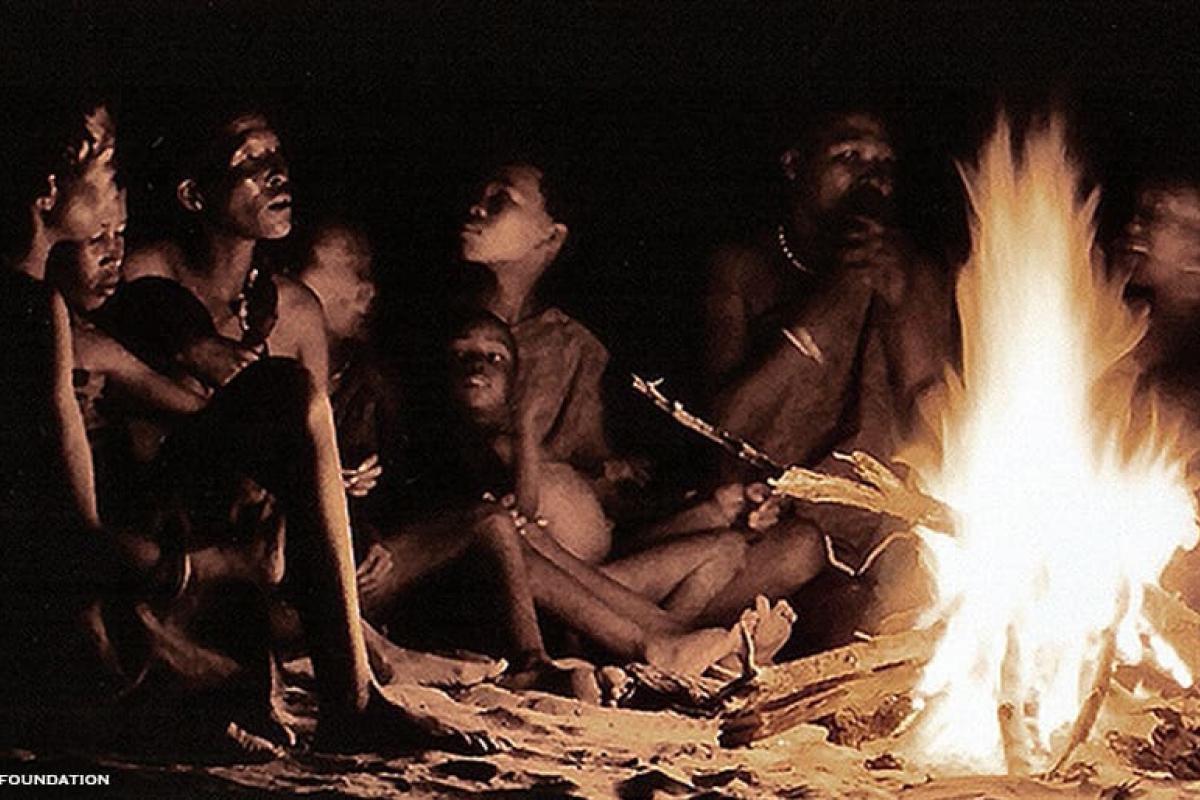
They were not like this before; the story has brought them together. In the warmth of the fire, they lean toward the storyteller, who is one of them, yet an outsider: she has gone away for a long time, she is crippled, or she is crazy. Perhaps she is a man.16 She tells them of the beginning of the world, the birth of the first people, the coming together of a culture, the origin of language and storytelling – a tale they all know, but only she has “the gift, the right, or the duty to tell” it (43), writes French philosopher and literary critic Jean-Luc Nancy in “Myth Interrupted” (1991).
Understanding is Making Up Stories about Chaos
(An extract from my book Narrative Madness, which can be acquired at narrativemadness.com or on Amazon.)
We, as language-users, constantly name ourselves, others, settings, actions, and events in an order that makes sense to us. We may not always use Don Quixote’s romantic language nor share his chivalric plot line, but he is only doing what all of us do: trying to make sense of the noise and confusion of life through narrative language. (Actually, you may think that you do not participate in the world of the chivalric romance, but I know you as you are: a furtive romantic, a closet hero.)
In the Name of the Book, In the Name of Cervantes, Amen
(From my book Narrative Madness, which can be acquired at narrativemadness.com or on Amazon.)
The Name of the Book
“What is it called?” and “Who wrote it?” are the first questions we as readers ask when deciding to read a book. Easy. The answers are printed on the fat novel to my right: Don Quixote by Miguel de Cervantes. Just a title and a name. We can almost pass by without a thought. How much significance could there be in so few words?
Actually, the title is fraught with meaning. The name invokes an image: a gaunt knight on a skinny white horse charging windmills. Most readers are familiar with the idiom “tilting at windmills,” which means fighting an imaginary enemy or engaging in a hopeless battle. Many will also know the adjective “quixotic,” defined by The Oxford English Dictionary (OED) as “naively idealistic; unrealistic, impracticable.” So when I say I am engaged in the quixotic quest for reality, I admit I am tilting at windmills, battling an imaginary enemy: namely, reality.