Yet even fiction is a fiction, a word which developed out of the Latin fingere, “to fashion or form.” In the Oxford English Dictionary, the first definition of “fiction,” now obsolete, is “the action of fashioning or imitating,” and is related to the verb “to feign.” The word first referred to all kinds of art, “The . . . Art of Painting . . . surpassing by so many Degrees . . . all other Human Fiction, or imitative Art” (Lord Shaftesbury in his Characteristicks).
When a Reader Enters a Book: Sampson and Quixote
How would you feel if you heard that a book had been written about you without your knowledge or permission? You would worry, I’m sure, about how it portrayed you. Unfortunately, Don Quixote has just learned from Sancho Panza that a book of their exploits is spreading across Europe and the book portrays him a madman and Sancho a fool. The knight dispatches his chubby squire to fetch the bachelor who has read the book El Ingenioso Hidalgo don Quijote de la Mancha.
La Mancha: The Stain of Truth
Mancha, in Spanish, means “stain,” and in La Mancha, the region Don Quixote comes from, everything is true. So, for our purposes the excellent word “Mancha” will symbolize truth, which stains every page of Cervantes’ masterpiece (not to mention your screen).
Don Quijote: The Impossible Truth
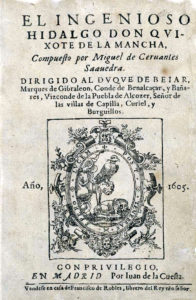 Don Quijote de la Mancha is the impossible truth: the book is a fiction, a lie, and yet it is true. Truer than a non-fiction biography of Cervantes. We would only read such a bio because we love our mad knight-errant and his earthy squire, Sancho Panza. The novel tells us much more about the real Cervantes than any bio could every do: valet, soldier, ransomed by pirates, soldier, tax collector, convict (jailed for discrepancies in the accounts while tax collector), poet, playwright, and the first modern novelist.
The Truthiness of Apples in a Basket
Absolute truth: My dad wrote in response to my blog, “There are countless absolute truths. Example: Two apples added to a basket containing two apples will make a total of four apples in the basket.” I agree absolutely. I believe in baskets and apples. I believe in reality. (What a ridiculous statement!)
Subjective truth: Let me take out the “I believe–” and say, “Reality exists.” (Was I able to remove the “I believe–“? I wrote the statement “Reality exists,” so it must be what I believe. Strangely enough the existence of reality has been in question for quite some time, maybe even some of you readers doubt reality.)
A Not Not-True Tale About a Very Short, Simple Morning
(A shortened version of this post appears in my book Narrative Madness, available at narrativemadness.com or on Amazon.)
I have just decided to write the non-fiction story of my short and simple morning so far. Since “fiction” is a story that is not true, “non-fiction” means it is not not-true. Cancel the negatives, and I am happy to say that the account I am about to give is true. The tale is easy to tell because it has only been half an hour since I woke up.
Well, more like forty four minutes. I said “half an hour” to emphasize the simplicity of my task, but I want to be accurate (I should add that at the time of this revision, fifty five minutes have passed [at this point of the third revision, two hours and twelve minutes during the third revision {and more than two years for this revision for my book Narrative Madness!}]). These facts are provable since I am using Google Docs and WordPress, which record the time of each revision. I haven’t even started telling the story of my morning, yet it is difficult to be accurate. I will do my best.