In my copy of Tristram Shandy, pages 23 to 68 came loose and I joked about mixing them up and reading them in a random order, but it doesn’t work. There is order to the disorder, organization to the chaos.
Narrative Madness
The Quixotic Quest for Reality
In my copy of Tristram Shandy, pages 23 to 68 came loose and I joked about mixing them up and reading them in a random order, but it doesn’t work. There is order to the disorder, organization to the chaos.
When Allegory invited me to a read and feed, I hesitated. He is a thin man, easy to overlook, his yellowish skin almost transparent. He wears a mishmash of musty, old-fashioned clothing: a toga and a biblical robe, medieval hose and cod piece, moccasins and a romantic scarf. Nothing modern, except maybe the combination.
Other meta-topics of interest, relating to language, thought, speech and writing. Enjoy!
Meta–: For the purposes of this blog, “the modern, inferred meaning of a higher-order, self-referential consideration of the nature of an activity—rather than actual, first-level participation in the activity” (Wikipedia article on Meta-discussion).

Is a novel defined by its length or by a certain approach? Can we consider a story that is not long a novel if it is epic in scope, representing a range of experiences and emotions? If so, isn’t Snoopy’s It Was a Dark and Stormy Night a novel?

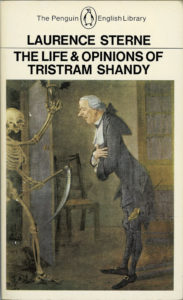
Shockingly audacious even today, Tristram Shandy was printed in installments from 1759 to 1769, about two hundred and fifty years ago. Laurence Sterne misuses the stuff novels are made of — the ink, the symbols, the pages, the fly-leafs — to make readers aware of the materiality of the book. Flipping through the novel you will come across a totally black page, front and back. I say totally black, but only the part of the page where the text normally appears is blacked out. The block of ink is framed by normal margins and includes page numbers (33 and 34 in my edition). The motivation for this famous black page is the exclamation “Alas, poor YORICK!”, which appears twice on the previous page.
 “The Things They Carried” is a short work of fiction. The Things They Carried is also the name of what could be called a short-story collection or perhaps a meta-fictional novel. It’s a pastiche of fiction, nonfiction, fantasy, memoir, author’s notations, and literary commentary.
Although the opening story stands alone as a work of fiction, it also functions as an introduction to the larger book. It establishes the major characters that recur throughout the “novel” and introduces many of the topics the book explores, themes as concrete as the Vietnam War and as abstract as how someone tells the truth about a historical event. O’Brien felt that straight facts could not convey an experience as ambiguous and disturbing as the Vietnam war. Yet O’Brien does not wholly rely on fiction either. He interweaves fact and fiction in the story (and throughout the book) to give the reader a more comprehensive sense of what it was really like to fight in Vietnam, to live in the face of death, and to carry on a purposeless existence.
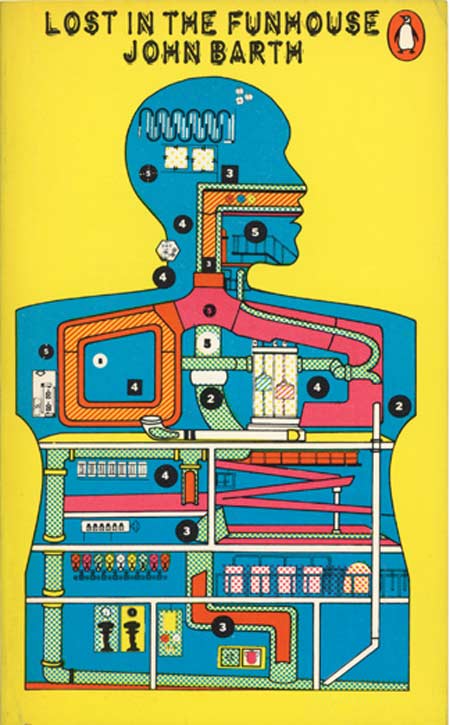 Although John Barth’s “Night-Sea Journey” from Lost in the Funhouse is barely six pages long, it is quite a journey, actually one which quickly expands into several voyages occurring simultaneously. Our first impression of the story is not at all like the second reading; it is a journey of a character we first assume to be human, a character we later realize is a sperm. This does not, however, stop us from reading the sperm as human, since he has a human voice and poses very human questions, it merely adds another layer. The sperm telling the story is an individual, but also a carrier of genetic heritage, the human voice, a purveyor of cultural heritage. The story itself is also implicated in the question of how it can be a unique work of art and still part of its literary heritage. The author does not resolve the question of identity and heritage, but hints at an acceptance, possibly a celebration, of our uncertain existence.
How would you feel if you heard that a book had been written about you without your knowledge or permission? You would worry, I’m sure, about how it portrayed you. Unfortunately, Don Quixote has just learned from Sancho Panza that a book of their exploits is spreading across Europe and the book portrays him a madman and Sancho a fool. The knight dispatches his chubby squire to fetch the bachelor who has read the book El Ingenioso Hidalgo don Quijote de la Mancha.
At the beginning of Book II, Don Quixote says, “tell me, friend Sancho, what do folks say of me about this town? what opinion has the common people of me? what think the gentlemen, and what the cavaliers? what is said of my prowess, what of my exploits, and what of my courtesy? What discourse is there of the design I have engaged in, to revive and restore to the world the long-forgotten order of chivalry?” (481). Sancho will only agree to discuss his lord’s reputation, however, if he promises not to get angry. The knight gallantly accedes.
Mancha, in Spanish, means “stain,” and in La Mancha, the region Don Quixote comes from, everything is true. So, for our purposes the excellent word “Mancha” will symbolize truth, which stains every page of Cervantes’ masterpiece (not to mention your screen).