There are two kinds of people in the world:
those who divide the world into two kinds of people and those who don’t.
Narrative Madness
The Quixotic Quest for Reality
There are two kinds of people in the world:
those who divide the world into two kinds of people and those who don’t.
 Borges’ “Borges and I” is such a wonderful piece of metafiction that I will just reproduce it whole for you here, with just enough of a comment to suggest that writing writes the writer, as I discussed in Who is Writing This? and It’s All Fiction, in which I discuss how every piece of writing requires the invention of a speaker, even a dictionary entry (the “nobody” speaker), so the requirements of the piece determines the voice and therefore the speaker. In the short fiction below, Borges is talking about how his fame has taken over his life (or, as Foucault would put it, his author function, his reputation as a great writer, has erased the real person).
Walking Backwards Through Time
We walk backwards through life, only seeing where we have been, not where we are going. From a physicist’s perspective, it is not clear why this is true. If we accept time as the fourth dimension and state that the universe is a four-dimensional object, why does our consciousness seem to move only in one direction along only one of four possible axes, yet we are only able to see in the direction opposite to our movement? This is not the only possibility imaginable. Many claim, for instance, that God is omnipresent in time as well as space, existing in all epochs at once, in other words he is outside of the illusion of time.
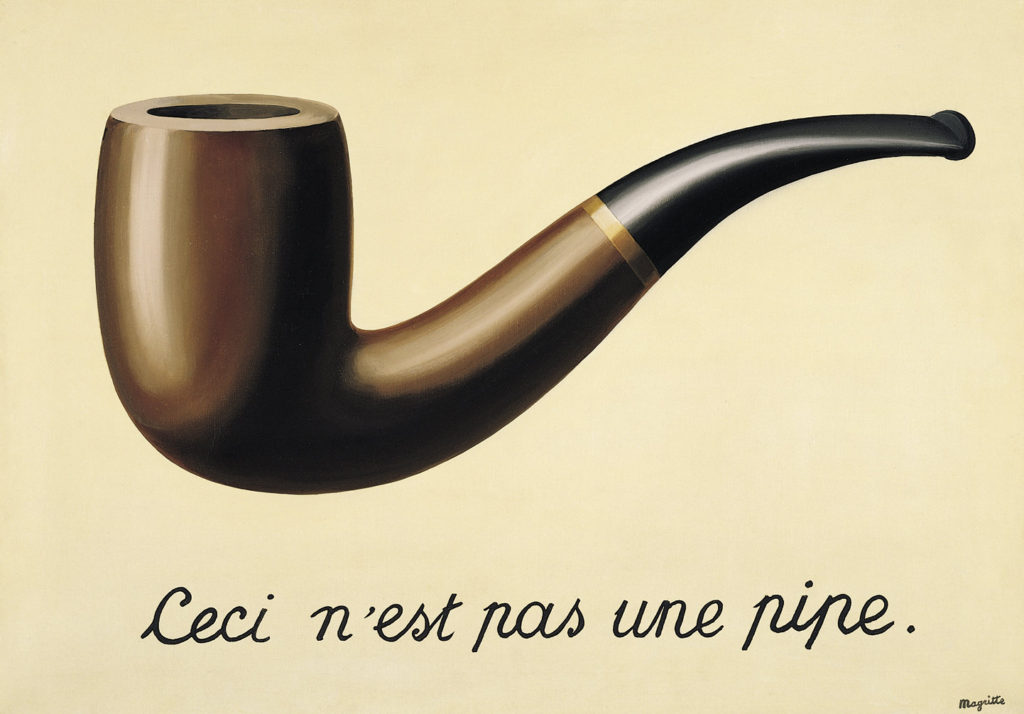
When first I came across René Magritte’s famous painting La trahison des images (The Treachery of Images), which says underneath a pipe in French “Ceci n’est pas une pipe”: “This is not a pipe,” I was quite confused. Of course it is a pipe. Just look at the painting!
I propose a simple test to check whether or not it actually is a pipe: put something in the pipe and smoke it. You can’t? Why not? If not a pipe, then what is it?
Las Meninas is a truly great meta-painting, a painting about paintings. A meta–painting may represent itself, the process of its creation, its materiality, the conventions of art, the gallery where it is hung, the artwork around it, and the place of art and artist in society.
At this point I count at least 23 meta aspects. Take a look at the painting yourself and see how many you can identify:

because I am still considering what title I want to use. Although I have already written about the play of form in Laurence Sterne’s book (Tristram Shandy ****s Up the Page, Progressive Digressions in Tristram Shandy, and The Stuff That Dreams are Made Of), there is so much more to say! I feel I could go on exploring metafictional elements in Tristram Shandy for years and never get to the bottom of the book. So here are just a couple of additions to my earlier observations of metafiction in Laurence Sterne’s masterpiece.
00011011100010101111001000011010111010010101001001111010001000000101010101110
cvlkjva [-09w8u} =t04 olsd; lkcmvfdkn [goiwe[oidufalkdm;olwih[ot9iyu=frik]; lfdkvna; leirthj ofiu so fijgs; lkrjt
word though there Sterne is attention black and of aware deal recommend the stridulous parcel burn it
In Tristram Shandy, Laurence Sterne draws the reader’s attention to the stuff a book is made of: the pages, the spaces, the ink, the letters, and the words. I have already written about this in “Tristram Shandy ****s Up the Page,” but much more could be said about the earliest and still most complete metafictional novel ever written.