Eros and the Arabesque: Eros and Shahrazad

Eros and Shahrazad

Freud expanded the concept of the pleasure principle, as he developed his theory of  the death drive, into a broader, more inclusive life drive, which he associated with Eros, the Greek god of sexual love: “the libido of our sexual instincts would coincide with the Eros of the poets and philosophers which holds all living things together” (Freud, “Beyond” 619). Eros represents not only the sexual instincts, but thirst, hunger, self-preservation, reproduction, and creativity. Shahrazad, who holds all the living tales of the book together, is “intelligent, knowledgeable, wise and refined. She had read and learned” (Nights 15). This educated woman approaches her father, the vizier, and demands that he offer her to the killer king.
Continue reading

Eros and the Arabesque: The Death Drive and King Shahrayar in the Arabian Nights

The Death Drive and King Shahrayar

Confronted with mounting evidence of a compulsion to reenact traumatic events, which the pleasure principle could not explain — victims of railway disasters, soldiers returning from World War I, and even children were obsessively reliving unpleasurable events in dreams, behavior, speech, therapy and games — Freud developed a theory of the death drive, more primitive and fundamental than the pleasure principle. According to Freud, the death drive is an urge to return to an inorganic state — basically a translation of the law of entropy into psychoanalytical terms. The law of entropy states that matter and energy tend toward a state of greater disorder. Organic life, ever recombining in more and more complex forms, runs contrary to entropy, reproducing in defiance of this fundamental law of physics. So, Freud argued, all organic matter longs to return to its original state, suggesting, therefore, that “the aim of all life is death” (Freud, “Beyond” 613).

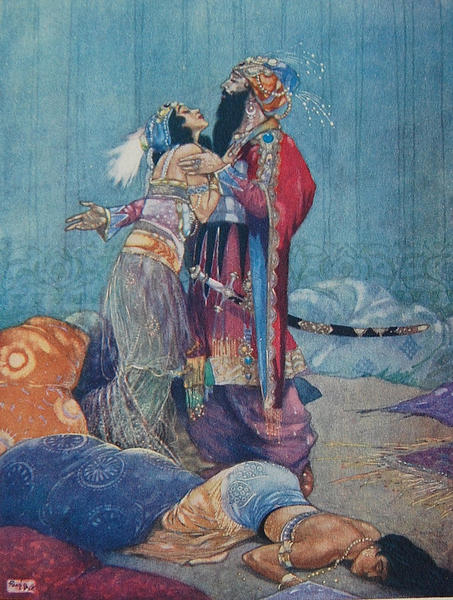
Scheherazade and Shahryar by Rene Bull

Continue reading

Eros and the Arabesque: Dangerous Extremes of Pleasure in the Frame Story to 1001 Nights

Dangerous Extremes of Pleasure in the Frame Story to 1,001 Nights

The sexual instinct, which Freud said is so hard to “educate,” can be carried to such extremes that pleasure becomes destructive, even self-destructive. From the point of view of self-preservation, Freud writes, the pleasure principle is “from the very outset inefficient and even highly dangerous” (Freud, “Beyond” 597). The prologue, which establishes the frame story of King Shahrayar and Shahrazad, is dripping with destructive sexuality.

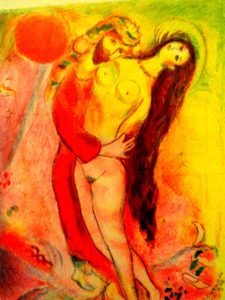
Marc Chagall’s “Shehrezed’s Night”
Continue reading

Eros and the Arabesque: The Serial Proliferation of Life in The Arabian Nights

Introduction

I have heard, O wise and happy Professor, that the end of the story is death, its continuation, life. For Shahrazad this is literally true. While the story continues, she lives. If the story ends, she dies. Full of jealousy and rage, the king has sworn to take a new wife every night, satisfy himself with her and kill her the next morning before his seed has dried in her womb. Thinking to save himself from the cunning of women, the king has unwittingly placed himself in a vulnerable position between orgasm and murder: under the tongue of the most cunning of women, the quintessential story-teller, Shahrazad.

Continue reading

Ronosaurus and I Present “Borges and I”

HacedorBorges’ “Borges and I” is such a wonderful piece of metafiction that I will just reproduce it whole for you here, with just enough of a comment to suggest that writing writes the writer, as I discussed in Who is Writing This? and It’s All Fiction, in which I discuss how every piece of writing requires the invention of a speaker, even a dictionary entry (the “nobody” speaker), so the requirements of the piece determines the voice and therefore the speaker. In the short fiction below, Borges is talking about how his fame has taken over his life (or, as Foucault would put it, his author function, his reputation as a great writer, has erased the real person).

Continue reading

History is an Angel Blown Backward Through Time

Walking Backwards Through Time

We walk backwards through life, only seeing where we have been, not where we are going. From a physicist’s perspective, it is not clear why this is true. If we accept time as the fourth dimension and state that the universe is a four-dimensional object, why does our consciousness seem to move only in one direction along only one of four possible axes, yet we are only able to see in the direction opposite to our movement? This is not the only possibility imaginable. Many claim, for instance, that God is omnipresent in time as well as space, existing in all epochs at once, in other words he is outside of the illusion of time.

Continue reading

If Not a Pipe, Then What?: Magritte’s Meta-Painting The Treachery of Images

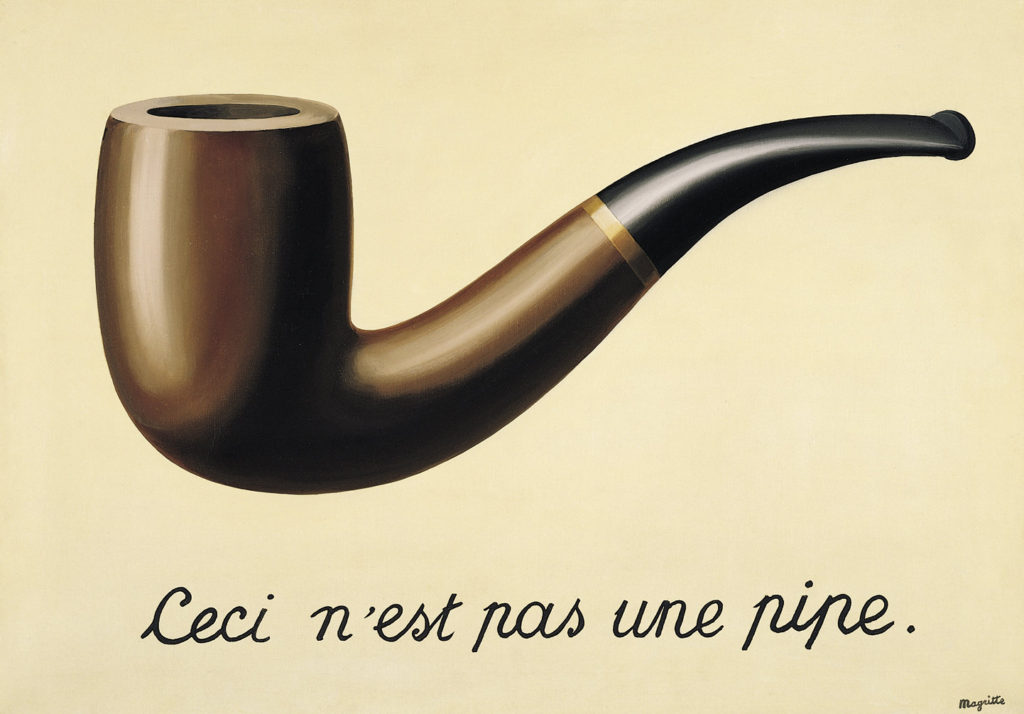
When first I came across René Magritte’s famous painting La trahison des images (The Treachery of Images), which says underneath a pipe in French “Ceci n’est pas une pipe”: “This is not a pipe,” I was quite confused. Of course it is a pipe. Just look at the painting!

I propose a simple test to check whether or not it actually is a pipe: put something in the pipe and smoke it. You can’t? Why not? If not a pipe, then what is it?

Continue reading

Las Meninas: A Meta-Painting

Las Meninas is a truly great meta-painting, a painting about paintings. A metapainting may represent itself, the process of its creation, its materiality, the conventions of art, the gallery where it is hung, the artwork around it, and the place of art and artist in society.

At this point I count at least 23 meta aspects. Take a look at the painting yourself and see how many you can identify:

Las Meninas

Continue reading