Words shape thoughts. For example, what is the defining act of sex? When have you moved from making out and heavy petting to doing the nasty? Most people would say the act of penetration. And who penetrates? A man! And who receives? A woman! What does this imply about the power relationship?
Dangerous Editors: Choderlos de Laclos’ Les liaisons dangereuses
 Les Liaisons Dangereuses by Choderlos de Laclos may not be what first comes to mind when you think of metafiction, but the the book is metafictional because it troubles the distinction between fiction and nonfiction. The book is told through a series of letters — the epistolary method — a device which gives a novel the illusion of being a collection of historical documents, as in Samuel Richardson’s Pamela (whose title page pronounces the book to be “A narrative which has its foundation in truth and nature”) and Daniel Defoe’s Robinson Crusoe (“written by himself” — as with Pamela, the real author’s name is not included on the title page).
The Limits of Language: Seuss Beyond Zebra
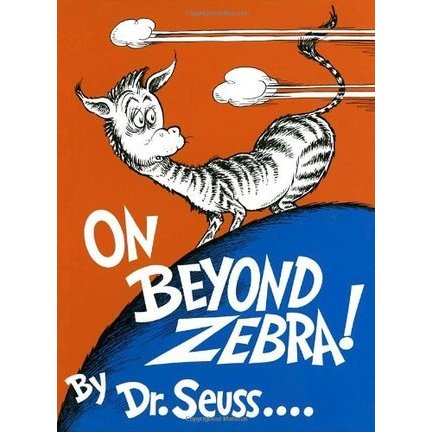 In On Beyond Zebra by Dr. Seuss, Conrad Cornelius o’Donald o’Dell, who is just learning to spell, writes out the alphabet on a chalkboard and says, “The A is for Ape. And the B is for Bear. / The C is for Camel. The H is for Hare.” He knows all the letters through to Z for Zebra. “So now I know everything anyone knows / From beginning to end. From the start to the close. Because Z is as far as the alphabet goes.” In other words, the alphabet allows him to learn about the known animals of the world, the implication being that without the alphabet he may never have known about hares or zebras.
A Simple Metapoem for an Oxymoron: You
Paradoxes and Oxymorons
by John Ashbery
This poem is concerned with language on a very plain level.
Look at it talking to you. You look out a window
Or pretend to fidget. You have it but you don’t have it.
You miss it, it misses you. You miss each other.
The poem is sad because it wants to be yours, and cannot.
What’s a plain level? It is that and other things,
Bringing a system of them into play. Play?
Well, actually, yes, but I consider play to be
A deeper outside thing, a dreamed role-pattern,
As in the division of grace these long August days
Without proof. Open-ended. And before you know
It gets lost in the steam and chatter of typewriters.
It has been played once more. I think you exist only
To tease me into doing it, on your level, and then you aren’t there
Or have adopted a different attitude. And the poem.
Has set me softly down beside you. The poem is you.
Why Meta Matters
Metafiction is the narrative quest for narrative, an attempt through stories to understand what stories are.
Why do stories matter? Because we are stories.
The Conventions of Unconventionality: An Overview of Metafiction
An overview of major themes I found while studying metafiction for the Metaclass, a self-study course for a masters of literature at San Francisco State University. This summary will also serve as a guide to the posts I have written over the last four months (with notes about a few others I intend to write). It is not meant to be a comprehensive list of meta conventions, but an addition to the the list found under Meta-Meta and Metafiction. (Nor is this intended to be a summary of themes I developed about writing and teaching, the metaclass aspect. Those themes may be found in Putting It All Together: Collaborative and Integrated Reading and Writing.)
I am the One the Writer of This Sentence is Referring to
Who is I? According to the Oxford English Dictionary, “I” is “used by the speaker or writer to refer to himself or herself.” Simple enough, but let’s think this out. The dictionary says that “I” is “used by the speaker or writer,” implying that “I” and “the speaker or writer” are not the same. How can this be? Well, one is a word and the other is a person. That “I” appears in the dictionary proves that “I” is a written or spoken symbol. Okay, so? The problem is that we confuse ourselves with that symbol. I think I am the “I.”
Where Did “I” Come From?
What is I? I is a letter. I is a word. Letters and words carry with them traces of their history, tracks that lead back in time.
Eros and the Arabesque: An End to 1001 Nights?
Conclusion?
 The Syrian manuscripts attempted to preserve and reproduce the “original” which stopped at two hundred and seventy-one nights but the Egyptian branch of manuscripts, Haddawy tells us in the introduction, “shows a proliferation that produced an abundance of poisonous fruits that proved almost fatal to the original” (Nights xv). Haddawy calls such additions “poisonous fruit” because he feels they destroyed its Arabic homogeneity. Besides deleting, modifying, adding, and borrowing from each other, “the copyist, driven to complete one thousand and one nights, kept adding folk tales, fables and anecdotes from Indian, Persian and Turkish, as well as indigenous sources, both from the oral and from the written traditions” (Nights xv). The tale of Sinbad is one such addition (the adventure is old, but its inclusion in The Arabian Nights is not). “The Story of Aladdin and the Magic Lamp” is actually a forgery written by a Frenchman named Galland and then translated into Arabic by a Syrian living in Paris to make it seem authentic, as evidenced by the French syntax and certain turns of phrase (Nights xvi).
Eros and the Arabesque: Death + Life = Stories, Stories and 1001 More Stories!
Death + Life = Stories, Stories and 1,001 More Stories!
Life and death intertwine in unusual ways in The Arabian Nights. The first tale is interrupted by morning: “but morning overtook Shahrazad and she lapsed into silence” (Nights 23). Morning is usually a sign of new beginnings, life and hope, but here it means death. Sir Richard Burton translated this line, “But Scheherazade perceived the morning–” Haddawy argues that Burton’s translation is not only inaccurate, but loses the poignancy of being pursued and overtaken by morning. Thus, “she lapsed into silence” is potent because silence is the end of the story and death. Will it be a permanent silence?

Hermann Emil Sprengel’s Scheherazade