How would you feel if you heard that a book had been written about you without your knowledge or permission? You would worry, I’m sure, about how it portrayed you. Unfortunately, Don Quixote has just learned from Sancho Panza that a book of their exploits is spreading across Europe and the book portrays him a madman and Sancho a fool. The knight dispatches his chubby squire to fetch the bachelor who has read the book El Ingenioso Hidalgo don Quijote de la Mancha.
When Don Quixote and Sancho Panza Hear of Their Book
At the beginning of Book II, Don Quixote says, “tell me, friend Sancho, what do folks say of me about this town? what opinion has the common people of me? what think the gentlemen, and what the cavaliers? what is said of my prowess, what of my exploits, and what of my courtesy? What discourse is there of the design I have engaged in, to revive and restore to the world the long-forgotten order of chivalry?” (481). Sancho will only agree to discuss his lord’s reputation, however, if he promises not to get angry. The knight gallantly accedes.
La Mancha: The Stain of Truth
Mancha, in Spanish, means “stain,” and in La Mancha, the region Don Quixote comes from, everything is true. So, for our purposes the excellent word “Mancha” will symbolize truth, which stains every page of Cervantes’ masterpiece (not to mention your screen).
Who Wrote Don Quixote?
Don Quixote is the first modern novel. But who wrote it? In the preface, the narrator states, “though I seem to be the father [I am] but the step-father of Don Quixote” (15). He has compiled and translated a book, we learn, written mostly by Cid Hamet Ben Engeli, “Arabian historiographer” (68), who gathered his material from various sources.
How to Sound Like an Author of Great Reading, Learning and Eloquence: A Quixotic Preface
Cervantes’ preface to Don Quixote is a caustic satire of academic writing, just as valid today as it was four hundred and five years ago. Full of delicious irony, Cervantes brags with the deepest humility. He points out the flaws in the book are its qualities.
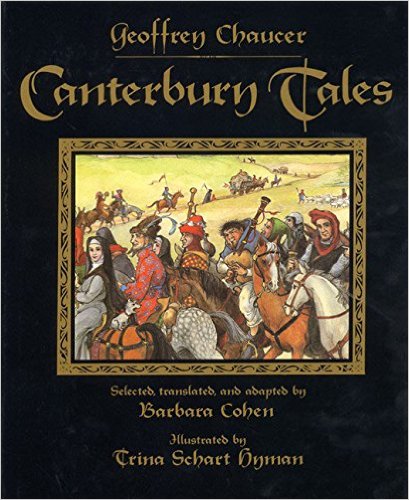
Chaucer: A Bad Poet and a Didactic Bore
What? What did that title just say? Now hold on just a moment! Who the hell does this Ronosaurus Rex think he is anyway, calling the first Great Poet (with a capital G and a capital P) in the English language “a bad poet and a didactic bore”? When I read “The Wife of Bath’s Tale,” for example, I remember delightful comedy, complex poetry and deep insight.
The Decameron With and Without a Frame
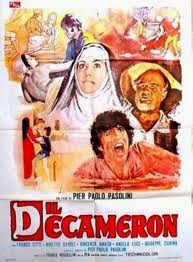 In Pasolini’s filmed version of The Decameron, he inexplicably leaves off Boccaccio’s frame story of a group of seven women and three men who retire to an estate in the country to avoid the plague that is ravaging Florence. There they tell each other stories to entertain, to cheer, and to instruct each other. Pasolini instead jumps right into a story, plays it out, then moves to another without explanation. He tells some interesting stories (and some of them are very sexy), but the film left me wondering why? What’s the point?
10,001 Nights: The Frame Stories Outside the Frame Story
Shahrazad’s story may frame the stories within The Arabian Nights, but many, many, many more stories surround it.
First of all, there is the complicated story of the Nights framing itself. The tales can be traced back to various ethnic origins, especially Indian, Persian and Arabic. In the endless tellings and retellings these stories were gradually reshaped to fit the Arabic culture of the middle ages, which gives the stories a “homogeneity or distinctive synthesis that marks the cultural and artistic history of Islam” (xiv).

The Power of Stories to Change the World: Another Arabian Night
 At the end of 1001 Ways to Save Your Life, Shahrayar was trying to save her life by telling a story to the murderous, mysogonistic Kaliph. She says her story “will cause the king to stop his practice, save myself and deliver the people” (21). The first story she told was of a merchant who inadvertently killed the son of a genie, by tossing away the pits of dates he was eating. The demon was about to slay the merchant, he raised his sword in the air–
1001 Ways to Save Your Life: Shahrazad and The Arabian Nights
The Arabian Nights is a story of stories. Not only is it a rich interwoven carpet of stories within stories within stories within stories, it is also a story about the power of stories, the power of fiction to save lives, to tame murderers and to change the world.
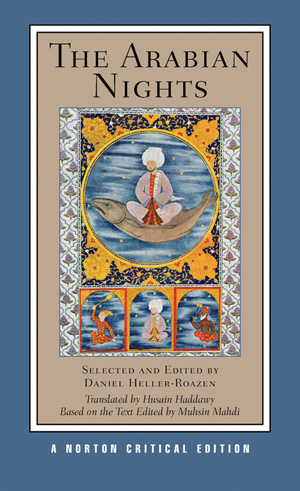
The most authentic English translation (by Husain Haddawy) begins, “It is related — but God knows and sees best what lies hidden in the old accounts of bygone people and times — that long ago, during the time of the Sasanid dynasty, in the peninsulas of India and Indochina, there lived two kings who were brothers” (5), reminding us from the very start that we are reading a story “related” by someone. Unlike the other stories in The Arabian Nights, we do not know who is telling us the frame story, the big tale that includes all other tales, instead we get the passive form “it is related,” followed by a warning that only God knows “what lies hidden in the old accounts,” in other words only Allah knows the truth of these fictions or even the secret meaning of them.