The Reader as Screenwriter, Producer, Director, Set Designer, Lighting Designer, Casting Director, Costume Designer and Actor (Part I)

(A condensed version of this study appears in my book Narrative Madness, which you can acquire at narrativemadness.com or on Amazon.)

I know a very talented individual who adapts literary works, produces and directs them, designs staging, lighting and costumes, casts the characters, plays every last one of them and sometimes adds music and special effects. This whirlwind artist accomplishes all this effortlessly, while sitting around the house in underwear and a t-shirt. That genius, my friend, is you!

When a writer walks away from a text, she vanishes. Roland Barthes calls this “The death of the author.” The death of the author, however, is the birth of the reader! So, let me be the first to congratulate you as you step in for the author and rewrite everything, animate the work and perform the text. A piece of writing, like a music score, is a set of mute symbols until it is played. Only then does it come alive.

Continue reading

Actors Playing Themselves

What does it mean when stars portray themselves? Are we getting a glimpse of  “the real person”? Far from it! We learn instead that the actor and the image are not the same person. Few performances are as artificial as those in which actors play themselves.

In an interview with the acclaimed actor Michael Cain, Michael Parkinson said, “Yours is the most impersonated voice in the business.” Cain responds, “Oh yeah, everyone– I– I can do it.”

“Can you do it?”

“Yeah, yeah . . . ‘Ello, My name is Michael Cain.” (When he says his name, it sounds like “my cocaine.”) The interviewer and the studio audience laugh. Michael Cain does not. He says, rather seriously, “I sound like a bloody moron.” What does it mean when an actor criticizes his own image?

Continue reading

Like This!: The Liking of the Liking of Liking

I just liked a new Facebook page called, “Liking.” I liked it before I liked it and I still like it. You should like it too. Why not?

The “Like” button on Facebook has changed the verb. Before Facebook, “like” was a positive emotion one felt towards a person or object, but now “liking” means pressing a button. Doing so means you like something in the traditional sense, so the like button refers back to the furry and friendly emotion. The button hasn’t replaced the feeling, so there is no reason not to like it.

Continue reading

Don’t Invalidate My Existence: A Meta-Dream

Sometimes I realize I am dreaming. Once, my college friend Robert Lochner and I were in line at the check-out counter of a grocery store. I told Robert I was dreaming as the cashier began to ring me up and that everyone in my dream was a figment of my imagination and that they would cease to exist as soon as I woke up. Robert, who was familiar with my philosophical posturing, rolled his eyes, but kept quiet, waiting for his turn at the register. The cashier, however, got very upset.

“I don’t care what you believe,” she said, pointing at me, “but don’t you invalidate my existence! You hear me? You can think whatever you want–I don’t care–but it is extremely, extremely rude to tell someone they don’t exist. How would you feel if I told you were just a character in my dream? A figment of my imagination? How would you like that?”

That is all I remember. I woke up. My friend Robert survived the dream although I haven’t heard from him in years. I was about to say that the cashier did not survive, but I have told this story several times and now I have written it down and sent it out into the cloud. The cashier doggedly continues her existence in spite of my insensitive comments. She exists. She is real.

(To read more about the reality of fiction, read my book Narrative Madness, available at narrativemadness.com or on Amazon.)

Repainting the Tenderloin: Mona Caron’s Meta-Mural “Windows into the Tenderloin”

Where did the name “The Tenderloin,” come from? Stories abound, but the one I first heard was that the Tenderloin neighborhood of San Francisco was so full of homeless people, drug addicts and prostitutes that the police get “hazard pay” to work there, which makes it possible for them to afford the better cuts of meat. Another story is that the police can afford fancier meat because they accept bribes from the entrepreneurs in the hood. Perhaps the name is a reference to the soft, vicious underbelly of San Francisco. Or to the tender loins of the prostitutes who work there. Or did we borrow the name from New York City’s Tenderloin, which has a similar reputation? Whatever the origin, the Tenderloin is not considered the choicest cut of San Francisco’s neighborhoods.

(Photo from Mona Caron’s website.)

Continue reading

A Meta-Island or a Meta-Lake?

Is this a meta-island? Or a meta-lake? Can nature be self reflective? Look down these photos from Taal Volcano in Taal Lake in the Philipines to see: “An island within a lake within an island within a lake within an island within the ocean.” And we can add one more island, as the earth is often called an island. We often compare space to water with metaphoric language like “The earth floats through space.” Couldn’t we also call the solar system an island? Could interstellar star dust be called a lake? What about a galaxy floating in dark matter? How far out could we zoom?

Continue reading

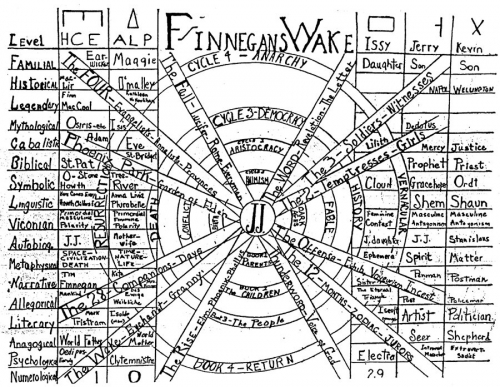
Hisstory Repleats Herself: James Joyce’s Finnegan’s Wake

Image from “Finnegans Wake, Fascism, and the Essential Unity of the Human Race” by Sean Ledwith

One of the most metafictional books: a story about a story that is repeated endlessly, the one story that is all stories at once, the cyclical story of the rise and fall of humanity.

Joyce essentially invented his own mishmash of languages, making the book notoriously difficult to read, but if you drink several glasses of Irish whiskey, smoke a few bowls and squint a lot the book becomes more readable . . . even funny! You should think of the novel as a great collection of puns.

Here is the first line: “riverrun, past Eve and Adam’s, from swerve of shore to bend of bay, brings us by a commodius vicus of recirculation back to Howth Castle and Environs.” Joyce packs in meaning by using puns and allusions (which are themselves a kind of pun). On a cursory count I find at least fourteen. “Past,” for example, is the preposition as in “the river flows past the church.” It also refers to the past, a central theme of the work. It can also be a homonym for the past tense of the verb “to pass”: passed. A Reader’s Guide to Finnegan’s Wake by William York Tindall explains some of the allusions: “‘Riverrun,’ the first word is the central word of the book; for Anna Livia’s Liffey, the feminine creative principle, is the river of time and life. The Liffey flows past the church of Adam and Eve (reversed here to imply temptation, fall, and renewal) and into Dublin Bay, where . . . it circulates up to Howth, the northern extremity of the bay. ‘Eve and Adam’s’ unites Dublin with Eden and one time with another” (Tindall 30).

Continue reading

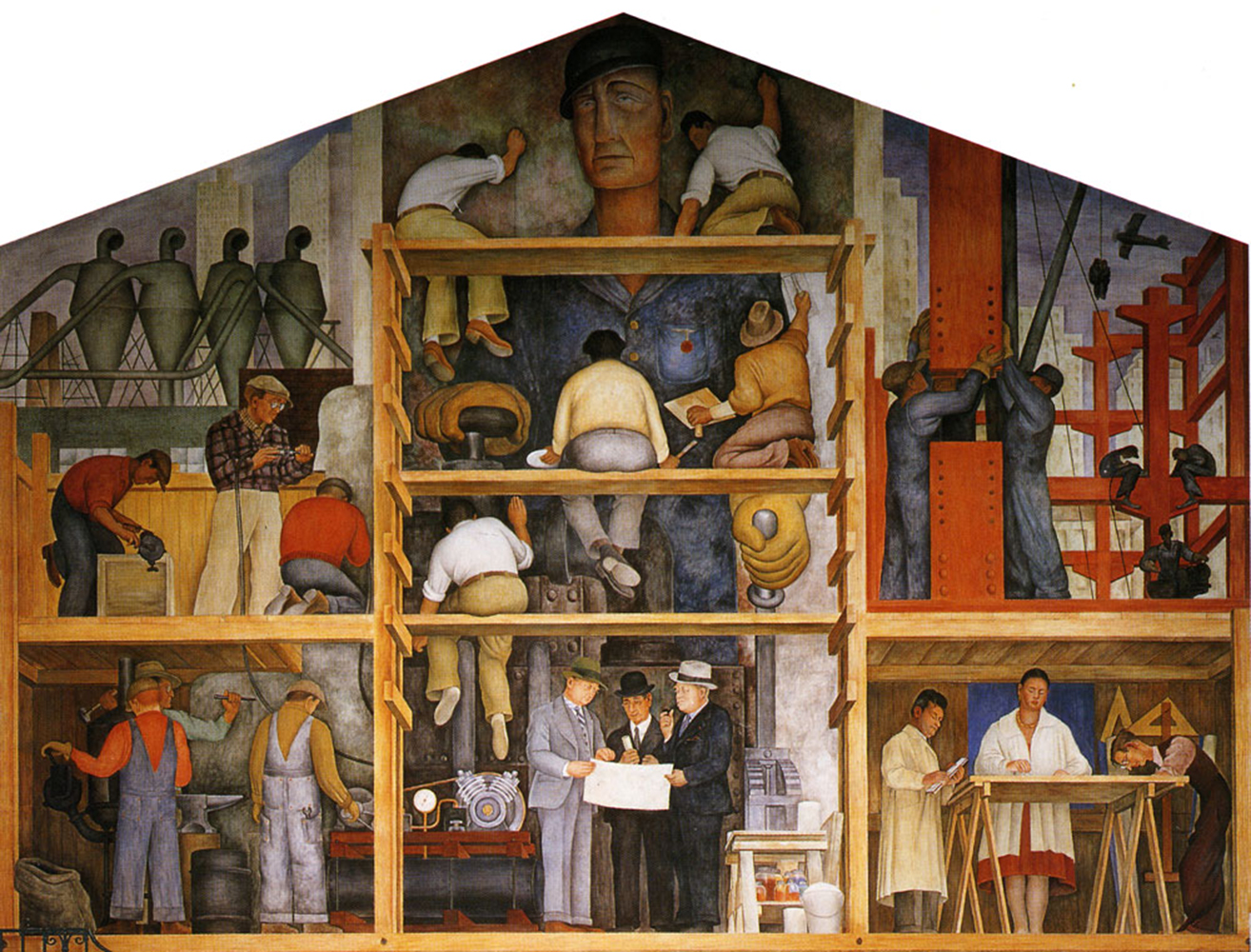
The Making of a Fresco Showing the Building of a City: Diego Rivera’s Meta-Mural

Diego Rivera Making of a Mural

In 1931, Diego Rivera (actually Diego María de la Concepción Juan Nepomuceno Estanislao de la Rivera y Barrientos Acosta y Rodríguez — whew, what a name!) painted The Making of a Fresco Showing the Building of a City at the San Francisco Art Institute. The mural is a meta-mural because it is a mural about murals and because it represents its creators in the act of creating the fresco itself.

Continue reading

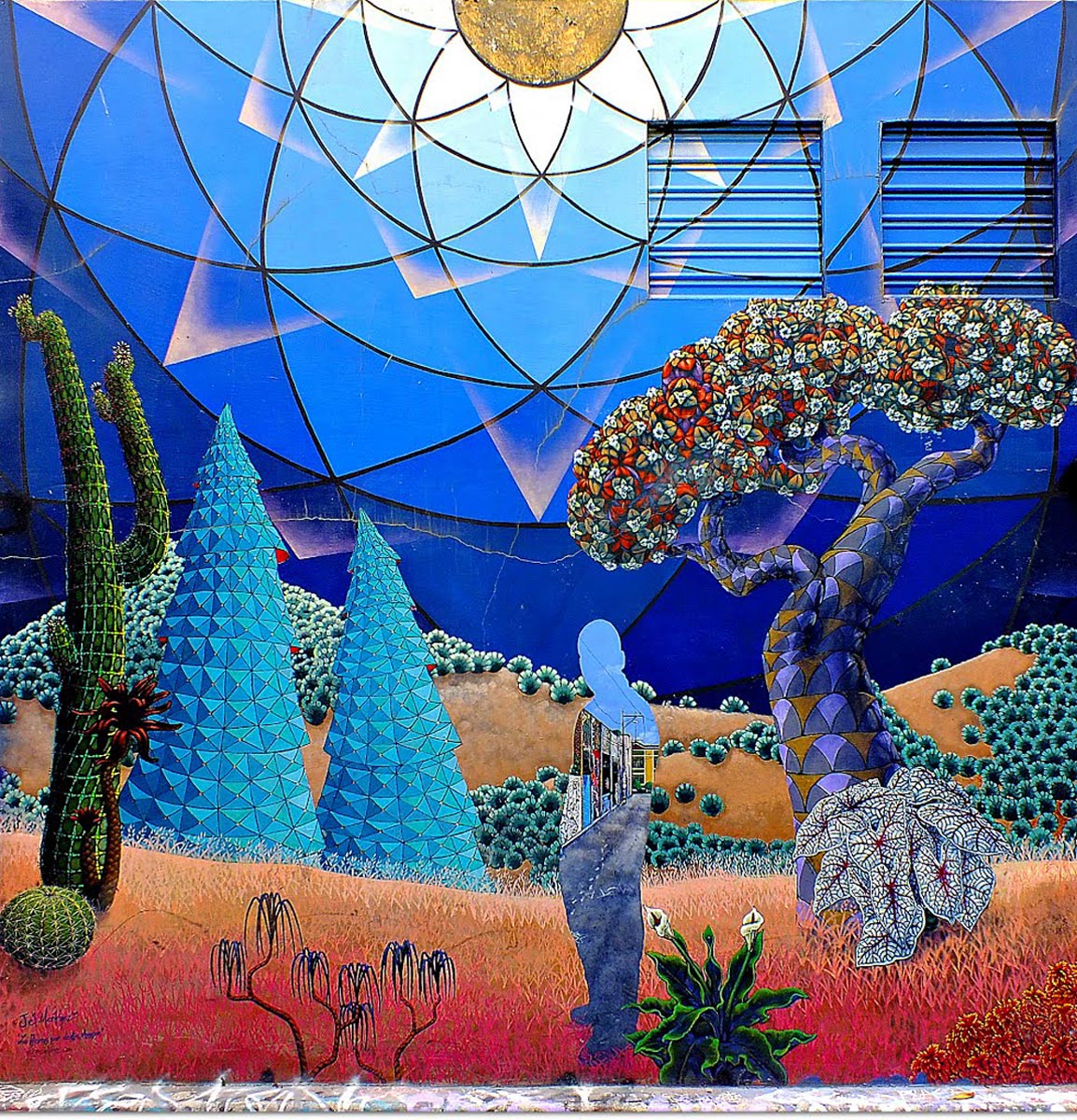
A Meta-Mural on Clarion Alley: Lo Llevas por Dentro by Jet Martinez

Clarion Alley in the Mission District of San Francisco used to be a shady street where junkies would shoot up. In October 1992, a volunteer collective of residents organized the Clarion Alley Mural Project (CAMP) to bring art and color to the alley. The murals of Balmy Alley, which are focused on Central American struggle, inspired the project, but the murals of Clarion Alley are generally more playful and cartoon-like, although they deal with serious social issues as well (“What I Know is What I Owe,” said one mural and another challenged the “Demonocracy” of the United States–both of these are now painted over). Many murals explore the rich culture of the Mission, especially, of course, the predominate Latino culture.

(Photo from Clarion Alley Mural Project)

Continue reading